

https://app.tamarind.bio/api/pipelines
Node Types
- User input: molecule groups or files that supply the starting molecules for the pipeline. This could be a protein to score, a protein target for a design tool, or a sequence to predict a structure.
- Tool: a tool on Tamarind which runs using input molecules and associates any output scores/files.
- Filter: allow you to restrict molecules from passing along further in the pipeline based on scores from tools. You can also keep only the top-ranked molecules by a score, or combine multiple upstream sources (union, or intersection by molecule).
Templates and Runs
- Pipelines are created as templates, which may be versioned, published, and re-run.
- Templates can be used to create runs, which execute a series of jobs on Tamarind using a given set of inputs.
- Only the creator of a pipeline may edit it by default, though anyone in the organization may run/duplicate it.
- A pipeline creator may grant admin access to other users, to allow them to edit the pipeline also.
- Template versions may not be edited after creation, and only 1 version of a pipeline may be published to your organization.
- Each node may contain multiple underlying jobs, which each run in parallel. A molecule may move forward in the pipeline if its corresponding job is complete before other jobs in its node have completed.
- You may test your template using test runs from the pipeline editor page before publishing it to your organization, available alongside other Tamarind tools and your organization’s custom tools.
- You may designate certain settings as editable by users in your organization.
Reference molecules
- A pipeline must be created with a reference molecule, which is used to test your pipeline, provide users with example input, and select any required chains throughout the pipeline (e.g. which chain to design, which chain to use as target).
- When a member of your organization uses the pipeline, they can input their own molecule.
- Input-specific settings: some tools may require you to choose a chain from your input molecule. The pipeline creator will select chains using their reference molecule, and the pipeline submitter will map their chains to the reference molecule at submission time. The submitter selects any residues on their own chain, such as hotspots or designed regions.
Running pipelines
- You may stop your pipeline to stop all running jobs and nodes, or stop a node to stop all downstream nodes.
- Results of your pipeline may be found at
/jobs/job-id. You may download the full tool raw results for a given node or the whole pipeline. You may also view all molecular groups associated with the pipeline, along with scores generated during the pipeline run. - Before you run a pipeline, a compute estimate will be shown for the weighted hours the pipeline will use. This is an estimate — we recommend running your pipeline with a small number of inputs, then scaling up to a production run.
Pipeline schema
A pipeline is a graph of nodes, allowing the outputs of one tool on Tamarind to be used as the inputs of another. It is defined as a JSON object, and this section explains the schema for that object. A pipeline is a map of node ids to nodes. The map keys are your node ids, which must be unique and are how nodes refer to each other.- JSON schema: pipeline-ir.schema.json
- Agent guide (.md): TAMARIND_PIPELINES_SCHEMA.md
Pipeline examples
The pipelines below are the starter templates covering a variety of use cases. Use these with thePOST /api/pipelines/templates endpoint to create a pipeline template. Replace
<groupId> with a molecule group id (from your organization’s molecule database,
GET /api/molecules/groups) before creating. Create a run from the template using the
POST /api/pipelines/templates/{id}/runs endpoint.
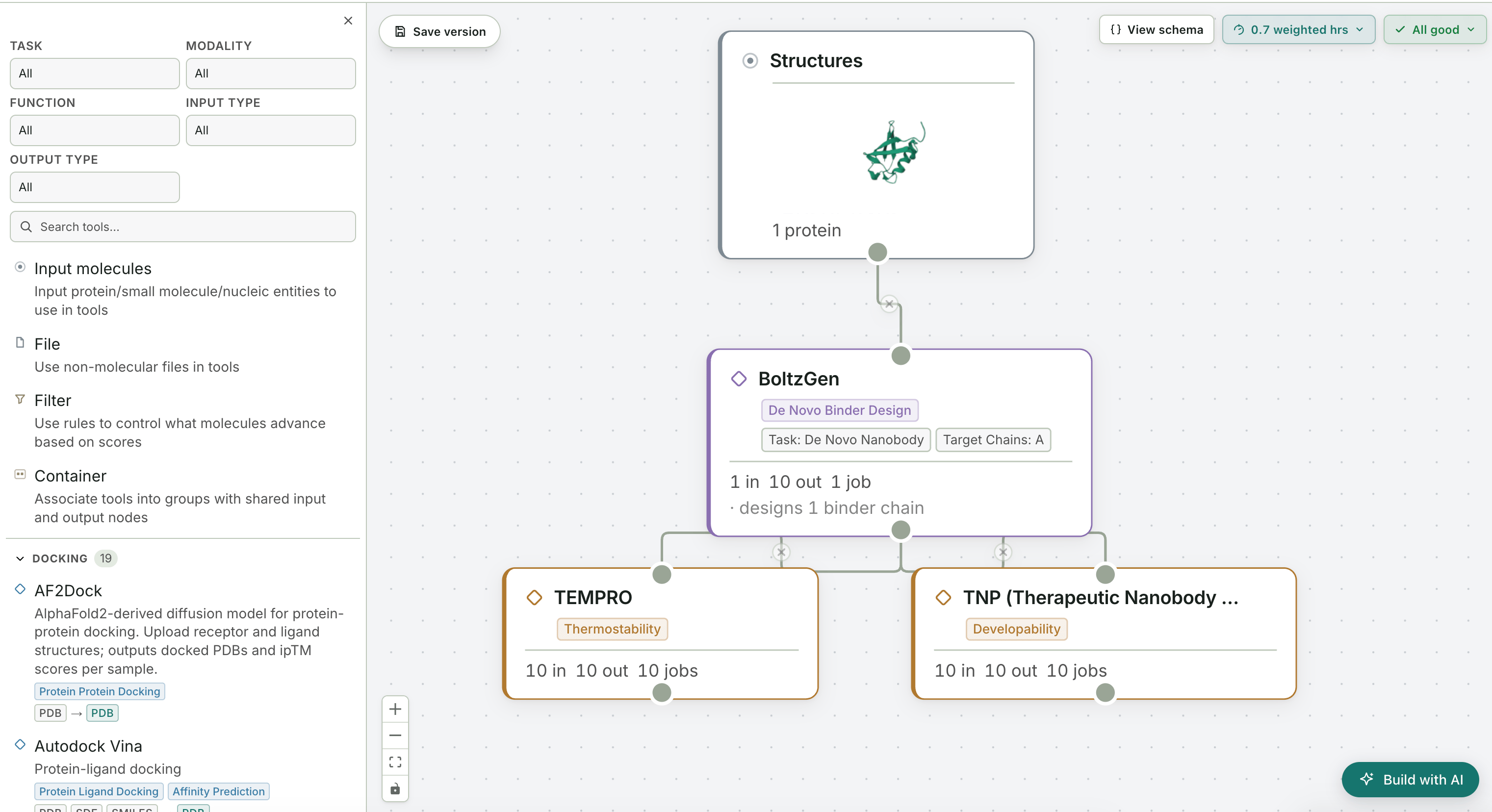
VHH design
VHH design
BoltzGen → TNP + Tempro. BoltzGen (de-novo-nanobody mode) mints VHHs against the target; each design is scored in parallel for immunogenicity (TNP) and thermostability (Tempro).
Antibody design
Antibody design
BoltzGen → DeepViscosity + BioPhi + TAP2. BoltzGen (de-novo-antibody mode) mints paired H+L; each design is scored in parallel for viscosity risk (DeepViscosity), humanness (BioPhi), and TAP2 developability metrics.
Antibody scoring
Antibody scoring
ANARCI × 2 + DeepSP + BioPhi + TAP2 + DeepSTABp × 2 + ImmuneBuilder → protein properties. Two ANARCI nodes number H and L independently; DeepSP, BioPhi, and TAP2 each take the H+L pair; DeepSTABp runs twice (per chain) for thermostability; ImmuneBuilder folds the antibody, then protein properties scores the folded structure.
Peptide design
Peptide design
RFPeptides → Boltz + PeptiVerse + PepFuNN. RFPeptides generates de novo peptide binders; each design folds with Boltz and is scored with PeptiVerse and PepFuNN in parallel.
Molecular Dynamics
Molecular Dynamics
AlphaFold → OpenMM MD. AlphaFold folds the input sequence; OpenMM runs energy minimization, equilibration, and production MD on the folded structure.
Small-molecule design
Small-molecule design
BoltzMol → ADMET + QupKake + LogP + FastSolv. BoltzMol mints de novo small molecules against the target; each design is scored in parallel for ADMET profile, microscopic pKa (QupKake), logP, and aqueous solubility (FastSolv). Solvent is a second input slot — bind it to a solvent MolDB group at run (water for aqueous).
Small-molecule scoring
Small-molecule scoring
ADMET + aqueous-solubility + LogP + FastSolv. Every input molecule flows into each scorer in parallel; FastSolv pairs each solute with the solvent input (water by default) so N solutes yield N solvent-specific solubility scores.
Inverse folding
Inverse folding
RFdiffusion3 → ProteinMPNN → AlphaFold. RFdiffusion3 (protein-binder-design task) generates backbones against the target; ProteinMPNN designs sequences on each backbone; AlphaFold refolds them so the designs can be validated against the intended binder geometry.
Enzyme design
Enzyme design
RFdiffusion3 → Boltz + CatPred. RFdiffusion3 runs in enzyme-design mode with residue-level scaffolding around the input active-site residues (carbonic anhydrase II, PDB 2VVB by default); each designed sequence folds with Boltz-2 and is scored for predicted Km against the substrate SMILES (bicarbonate) with CatPred in parallel.
Miniprotein design
Miniprotein design
BindCraft → NetSolP + TemstaPro. BindCraft integrates backbone and sequence generation against the target; each binder sequence is scored for solubility (NetSolP) and thermostability (TemstaPro) in parallel.
Small-molecule electronic properties
Small-molecule electronic properties
Tautomer → conformer generation → electronic properties + charge/dipole + electrostatic potential + H-bond strength. Tautomers are enumerated and 3D conformers embedded; each conformer is then scored in parallel for charge/dipole, electrostatic potential (V_min/V_max/V_mean), electronic properties (HOMO/LUMO/gap), and per-site H-bond donor/acceptor strength.
Protein scoring
Protein scoring
TemstaPro + NetSolP + AlphaFold → Aggrescan3D + protein properties. TemstaPro (thermostability) and NetSolP (solubility) run directly on the sequences in parallel; AlphaFold folds each sequence, then Aggrescan3D (aggregation propensity) and protein properties run on the folded structure.
Benchmark structure prediction
Benchmark structure prediction
AlphaFold + Boltz + Chai + ESMFold2 + OpenFold + OpenDDE + Protenix → rmsd-calculator. Every predictor folds the input sequence in parallel; all seven predicted structures feed a single rmsd-calculator node against the reference PDB (fan-in on
pdbFile1), producing one RMSD row per predictor.Ligand scoring
Ligand scoring
Gnina → GBSA + RBFE. Gnina docks each candidate against the target with a whole-protein search; the docked poses fan out to MM-GB/PB(SA) endpoint rescoring and RBFE free-energy perturbation in parallel. Swap the default SMILES ligand for an SDF-bearing group before submit.
Interface evaluation
Interface evaluation
AlphaFold → DockQ + RMSD. AlphaFold-Multimer folds the multichain sequence as a complex; the prediction is scored against a reference native with DockQ (interface quality) and rmsd-calculator (backbone RMSD). Needs a multichain input AND a paired multichain reference — swap the 1UBQ placeholder for the real crystal before submit.
Small-molecule-binding protein design
Small-molecule-binding protein design
LigandMPNN → Boltz. LigandMPNN samples new sequences on the fixed scaffold conditioned on the bound ligand; each design is co-folded with the same ligand by Boltz to validate that the redesigned pocket still docks the small molecule.
Structure search
Structure search
AlphaFold → FoldSeek. AlphaFold folds the query sequence; the predicted structure is used as a FoldSeek query against the PDB. Useful for finding structural homologs when sequence-search returns nothing. To search AlphaFold DB, Swiss-Prot, ESMAtlas, or a custom database, duplicate the template in the full editor and change the FoldSeek node’s
database setting.Node kinds
There are four kinds, set by each node’skind field:
- user_input — Use a molecule group from the Tamarind molecules database or a file as
inputs into the pipeline. In a pipeline template, a molecule input is used as the default
or reference group it’s authored against in
metadata.defaultGroup(required at create/publish). Each run of a pipeline template is submitted with its own group, which is mapped to the reference group at submission time. - tool — runs a computational biology tool on Tamarind, named by
tool, and can have either user_input or other tool/filter nodes as inputs. - filter — narrows or combines results: gather sources on its
inport. Can either filter for top K of a given metric, or for specific thresholds on tool scores. Can either combine through intersection (a molecule must be present in all input sources) or union (a molecule must be present in any input source). - container — groups several nodes behind one shared input and output handle, so you can wire a source into a set of tools (and gather their outputs) with a single edge. See Containers below.
Reference molecule group
Every moleculeuser_input names a reference molecule group in its
metadata.defaultGroup, and one is required to create or publish a template. The reference
group is the example molecules the pipeline is created against: it tests the pipeline, shows
users what a valid input looks like, and is how you select any required chains throughout the
pipeline, such as which chain to design, score, or use as the target.
When a member of your organization runs the pipeline, each run is submitted with its own
group at submission time. The reference group defines the shape of the input, not the data
every run must use.
Connecting nodes
A node names its upstream sources inside each input setting. A setting’s value is a list of references to upstream node ids. Listing several sources on one port combines (unions) them.Filters
A filter node combines its sources if there are multiple (union by default, or intersect by molecule identity), and narrows them with an ordered list of rules. A rule is either a defined threshold over molecule attributes (e.g. confidence > 0.9), or a ranked top-K filter that keeps the top results by a score. The confidence example below keeps only molecules whose overall confidence is above a threshold. For advanced use cases, you can define custom rules using jsonlogic to define arbitrary and/or relationships between predicates.Filter rules & score columns
A predicate rule reads a molecule’s score by column name —{ "var": "overall_confidence" }
— and a Top K rank_by names a column the same way. Column names are the metrics a tool
produces (its output columns).
When two tools feeding one filter produce a column with the same name, prefix it with the
producing tool to target one specifically: { "var": "<tool>.<column>" }, where <tool> is
the same string used in that node’s tool field — e.g. boltz.plddt vs chai.plddt. You
can also use a score’s name directly, which still resolves to whichever connected tool carries
that score.
Containers
A container groups several nodes behind one shared input handle and one shared output handle. Connecting another node or container to a container’s input is the same as connecting it to every member node inside the container. This allows you to simplify your pipeline structure by grouping multiple related tools together.Tool settings
A tool node’ssettings are validated against that tool’s own field schema. To see every
setting a tool accepts — names, types, defaults, and which task each applies to — call
GET /api/tools/{name}/schema (and GET /api/tools to list the available tools). The
examples below show a few real settings; the schema endpoint is the full, authoritative list.
Worked examples
Diversify and predict structures. Diversify an input structure’s sequence with ProteinMPNN, keep only the high-confidence designs with a filter, then predict a structure for each with AlphaFold.End to end example
Redesign an input structure’s sequence with ProteinMPNN, then fold each design with AlphaFold — create the template, bind your molecule at submit, and poll until it finishes.group, plus the residues to act on
(residuesByChain) and — only if your molecule’s chain labels differ from the template’s
reference chains — a chainMapping. Call POST /templates/{id}/validate first to pre-flight
a run without submitting.